What Is a Pneumatic Cylinder Knife Edge Gate Valve and How Does It Work in Industrial Applications?
Industrial processes that handle slurry, wastewater, pulp, powders, and other challenging materials require reliable flow isolation. Conventional valves may not suit every application, especially when the medium contains suspended solids, fibrous materials, or thick sludge. A Pneumatic Cylinder Knife Edge Gate Valve is designed for applications where a sharp-edged gate cuts through the medium to control flow.
This valve combines a knife gate mechanism with a pneumatic cylinder actuator, allowing compressed air to open and close it. It is commonly considered for industrial systems that require automated isolation of pipelines carrying liquids, slurries, and solids-laden fluids.
For industrial buyers, engineers, and maintenance professionals, understanding valve construction, operating principles, and application requirements helps ensure appropriate product selection.
Focet Valves Pvt Ltd can be approached for industrial valve requirements, with product suitability determined by the application, operating conditions, and verified technical specifications.
This guide explains what a pneumatic cylinder knife edge gate valve is, how it works, its components, benefits, applications, and the factors to consider when selecting a suitable valve.
What Is a Pneumatic Cylinder Knife Edge Gate Valve?
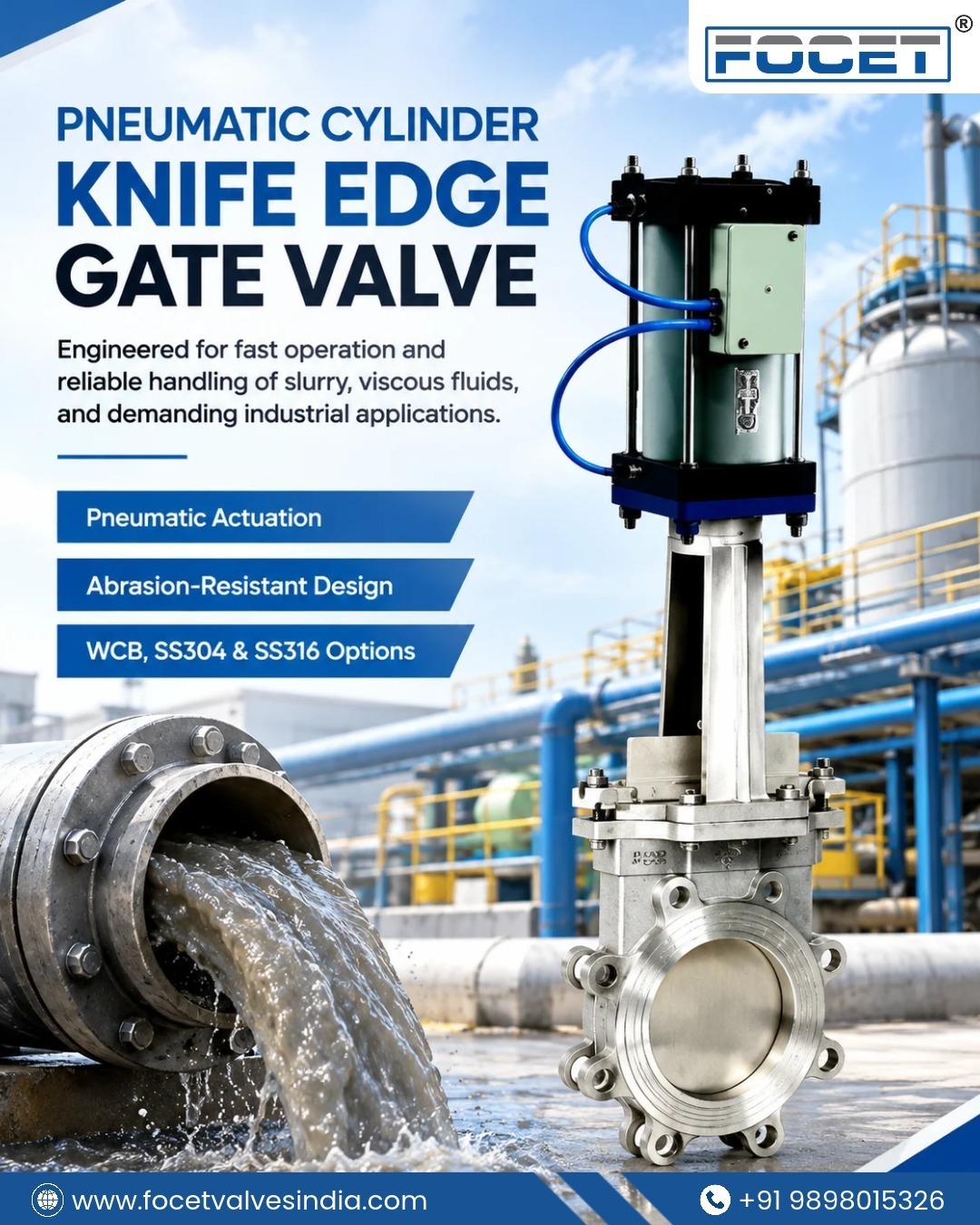
A pneumatic cylinder knife edge gate valve is an industrial isolation valve that uses a sharp-edged gate, commonly called a knife gate, to control the flow passage through a pipeline. A pneumatic cylinder moves the gate between its open and closed positions using compressed air.
Unlike conventional gate valves, which are primarily for general pipeline isolation, knife gate valves are often selected for applications involving slurry, sludge, pulp, powders, and fluids with suspended solids. The knife-like gate can help cut through fibrous or semi-solid material during closure, depending on the valve design and medium.
The pneumatic actuator makes this valve suitable for automated installations requiring remote operation and integration with plant control systems.
Verify the exact construction, pressure rating, body material, sealing arrangement, and operating limits against the manufacturer’s technical datasheet before installation.
How Does a Pneumatic Cylinder Knife Edge Gate Valve Work?
The valve operates through the coordinated action of a knife gate and a pneumatic cylinder. Compressed air provides the force needed to move the gate to its open or closed position.
1. Compressed Air Is Supplied
An appropriate compressed-air supply delivers air to the pneumatic cylinder through a control arrangement. The required air pressure depends on the actuator design and the valve’s operating requirements.
2. The Pneumatic Cylinder Moves the Gate
Air pressure moves the actuator piston, which transfers motion to the knife gate through the connecting mechanism. Depending on the actuator configuration, air may be used to open or close the valve.
3. The Gate Opens the Flow Passage
In the open position, the gate moves clear of the intended flow passage, allowing material to move through the valve. The actual flow capacity depends on the valve’s internal geometry, size, and operating conditions.
4. The Gate Moves Toward Closure
When a closing command is issued, the pneumatic actuator moves the gate toward the closed position. The sharp edge can help cut through suitable fibrous or solids-containing media.
5. The Valve Isolates the Pipeline
Once the gate reaches its closed position, the valve restricts the flow according to its design and sealing capability. The achievable shutoff performance depends on the seat arrangement, material characteristics, differential pressure, and valve condition.
Important: A knife gate valve should not automatically be assumed to provide bubble-tight shutoff or suitable throttling performance. Confirm the manufacturer’s specified leakage class and intended operating duty before selecting the valve.
What Are the Main Components of a Pneumatic Knife Gate Valve?
Understanding the main components helps buyers evaluate valve construction and maintenance requirements.
· Valve Body: Houses the gate and connects to the pipeline.
· Knife Gate: A sharp-edged plate that moves across the flow passage to open or close the valve.
· Pneumatic Cylinder: Converts compressed-air pressure into mechanical movement.
· Actuator Stem or Connecting Rod: Transfers movement from the actuator to the gate.
· Sealing Arrangement: Restricts leakage around the gate, depending on the valve design.
· Seat: Provides the designated sealing surface when the gate closes.
· Air Control Components: May include solenoid valves, air lines, and position-control accessories, depending on the automation arrangement.
· Position Indicator or Limit Switches: Can provide open and closed position feedback when included in the configuration.
Component materials, accessories, and actuator arrangements vary between models. Review the product datasheet to confirm the required valve configuration.
What Are the Advantages of a Pneumatic Cylinder Knife Edge Gate Valve?
A pneumatic knife gate valve can offer several benefits when properly matched to the process.
Automated Operation
Pneumatic actuation uses compressed air, making the valve suitable for automated industrial installations.
Handling of Solids-Containing Media
The knife gate design can help move through certain slurries, fibrous materials, sludge, and other challenging media.
Remote Control Integration
With suitable control accessories, the valve can be integrated into a plant’s control system for remote operation and position monitoring.
Practical Pipeline Isolation
Knife gate valves are designed primarily for on-off isolation in applications where their construction and sealing characteristics are appropriate.
Potential Maintenance Benefits
The valve's suitability for the process medium can support maintenance planning. Actual maintenance requirements depend on wear, abrasion, corrosion, operating frequency, and the valve design.
Application Flexibility
Different configurations and materials may be available for specific industrial duties. Selection must be based on the manufacturer’s verified product range.
Where Are Pneumatic Cylinder Knife Edge Gate Valves Used?
Pneumatic knife gate valves are used in several industrial sectors that require pipeline isolation.
1. Wastewater Treatment Plants
Wastewater systems may contain suspended solids, sludge, and fibrous matter. A suitably designed knife gate valve can help isolate compatible pipeline sections during operation and maintenance.
2. Mining and Mineral Processing
Mining operations often transport abrasive slurries containing mineral particles. Valve selection should account for particle size, abrasion, slurry concentration, pressure, and material compatibility.
3. Pulp and Paper Industry
Pulp processing involves fibrous materials and process fluids that can challenge conventional valve designs. A suitable knife gate valve may be used for isolation in compatible applications.
4. Chemical Processing Plants
Chemical facilities may require valves to isolate process fluids. Body materials, seals, and other wetted components must be compatible with the chemical composition, temperature, and pressure.
5. Power Generation Facilities
Some power plants use valves in ash handling, slurry transfer, and other solids-containing systems. The valve must suit the specific medium and process conditions.
6. Cement and Bulk Material Handling
Industrial facilities handling powders and solids may use specially configured knife gate valves in compatible systems. Assess dust characteristics, particle size, operating pressure, and the required sealing arrangement.
7. Industrial Slurry Pipelines
A suitable Slurry Gate Valve can help isolate pipelines transporting mixtures of liquid and solid particles. Key selection considerations include abrasion resistance, gate movement, seat design, and pressure requirements.
How to Select the Right Pneumatic Cylinder Knife Edge Gate Valve
Choosing the right valve requires careful evaluation of the process conditions rather than relying on nominal pipeline size alone.
1. Identify the Process Medium
Determine whether the pipeline carries wastewater, slurry, pulp, powder, or another industrial material. Consider solids concentration, particle size, viscosity, abrasiveness, and chemical properties.
2. Confirm Operating Pressure and Temperature
Verify the normal and maximum operating pressure and temperature. Ensure the selected valve and actuator suit the required operating conditions.
3. Select the Appropriate Valve Size
Match the valve’s nominal size and connection arrangement to the pipeline and required flow capacity. Consider installation dimensions and available space.
4. Check Body and Gate Materials
Material selection should account for corrosion, abrasion, fluid compatibility, and the expected service life.
5. Evaluate the Sealing Requirements
Determine whether the application requires one-directional or bidirectional shutoff and what leakage performance is acceptable. Confirm the actual capability with the manufacturer.
6. Choose the Pneumatic Actuator Configuration
Check the available air supply, required actuator force, operating frequency, control method, and whether position feedback is needed.
7. Consider Installation and Maintenance
Review pipeline orientation, inspection access, actuator clearance, and the manufacturer’s installation and maintenance recommendations.
8. Verify Technical Documentation
Before ordering, request the relevant product datasheet, pressure and temperature limits, material details, connection standards, and applicable test documentation.
Pneumatic Knife Gate Valve Supplier for India and International Markets
Industrial buyers sourcing valves for domestic or overseas projects should assess product suitability, documentation, supply capabilities, and technical support.
Businesses searching for a Pneumatic Knife Edge Gate Valve Manufacturer in India should compare valve construction, actuator specifications, material compatibility, and the manufacturer’s documented capabilities.
An Industrial Valve Supplier in India should be able to clarify relevant technical details and help buyers identify a suitable product configuration for the intended service.
For overseas projects, buyers looking for a Pneumatic Gate Valve Gulf solution or a Knife Gate Valve Oman supplier should confirm destination-specific requirements, export documentation, delivery terms, and after-sales support.
Contact Focet Valves Pvt Ltd to discuss industrial valve requirements. Confirm product availability, manufacturing status, export coverage, and technical specifications directly with the company before making a purchase decision.
Frequently Asked Questions (FAQs)
1. What is a pneumatic cylinder knife edge gate valve?
It is an industrial isolation valve that uses a sharp-edged gate operated by a pneumatic cylinder. Compressed air moves the gate between open and closed positions.
2. How does a pneumatic knife gate valve work?
Compressed air operates the actuator, which moves the knife gate to open or close the flow passage. The exact operating sequence depends on the actuator configuration and control arrangement.
3. What is a pneumatic knife gate valve used for?
It is used for compatible industrial isolation applications involving slurry, wastewater, pulp, sludge, and certain solids-containing media.
Keywords